
Hallpass Journal / Search & discovery
AEO and GEO for economic development: make your community easier to find in AI search
Start by making your community's business information easier to answer, check, and keep current.

In this article
- Start with the questions site selectors ask about your community
- Give each community answer a reliable page on your EDO website
- Distinguish verified community facts from promotional claims
- Check technical SEO before investing in AI search shortcuts
- Coordinate community information across partner websites
- Use local business stories to explain your community’s evidence
- Track AI answers about your community, accuracy, and inquiries
- Start community AI search work with a manageable EDO checklist
For an economic development organization, AEO and GEO should begin with clear answers to real location questions, supported by current evidence on accessible web pages. Check whether search systems can reach those pages, coordinate facts with your partners, and track what AI answers actually say about your community.
Here, answer engine optimization (AEO) means preparing information to help answer a question. Generative engine optimization (GEO) focuses on discovery and representation in generated answers. The labels overlap. Neither is a promise that an AI system will recommend your community.
The useful goal is specific: when someone investigates whether your community fits a project, can they find an accurate answer and a reliable next step?
Start with the questions site selectors ask about your community
“Put our city in AI search” is difficult to turn into a work plan.
A more useful starting question is: “What would someone need to know before considering our community for this kind of project?”
For a manufacturing prospect, that might involve relevant occupations, training programs, available buildings, utility contacts, and freight connections. For a professional-services operation, the first questions may be different.
Use your actual inquiries and staff conversations to build a question list. The following are example research scenarios, not measured site-selector search queries:
- What machining training is available near this community?
- Which industrial properties have current public specifications?
- Who can assess electrical service for a proposed facility?
- Where can a prospect find the area's occupational wage data?
- Which organization coordinates an initial project conversation?
Begin with five questions you can answer well. A hundred thin pages will not repair missing facts.
Give each community answer a reliable page on your EDO website
Imagine a technical college has a detailed page about a training program, your EDO has a vague workforce paragraph, and the city links to an old brochure.
The first task is to connect the useful information.
On the EDO page, explain the program's relevance to the industry in plain language. Name the college and community, link to the current program page, and identify the person who can confirm details. Keep enrollment dates, credentials, and outcomes consistent with the source.
Use a repeatable answer structure:
| Element | What to include |
|---|---|
| Direct answer | A short response to the page's main question |
| Place | Full community and state name; define any regional boundary |
| Evidence | Named source and the period the information describes |
| Limits | What the information does and does not establish |
| Next step | Relevant contact or current official program page |
| Maintenance | Content owner and a date for the next review |
Think of the page as a labeled file someone else needs to use. A good label helps; the contents still need to be accurate.

Distinguish verified community facts from promotional claims
“We have the workforce you need” bundles several unanswered questions.
Which occupations? Which geography? What year? What does the data measure? Can a prospect contact someone who understands it?
A more useful page might explain which occupational estimates are available, show the relevant geography, and connect readers to a local training partner. Employment counts alone do not establish how many people are available for recruitment.
Use the same discipline for property and utility information. Identify the site, date, and responsible source. Distinguish existing service from planned improvements and technical questions that still require assessment.
Our site-selector communications guide provides a working checklist for these answers.
Check technical SEO before investing in AI search shortcuts
Google's guidance for AI Overviews and AI Mode says established SEO practices still apply. A page must be indexed and eligible for a search snippet to qualify as a supporting link; inclusion is not guaranteed.
Google recommends crawl access, useful internal links, important information in text, and structured data that agrees with the visible page. It says no special AI file or schema is required for these features.
Ask your website team to check the pages containing your most important answers against that guidance. Use Search Console to investigate indexing issues. Keep program requirements available as readable text even when a PDF supplies additional detail.
That guidance is about Google's search features. Other platforms have their own controls.
For ChatGPT search, OpenAI's crawler documentation distinguishes OAI-SearchBot, used for search discovery, from GPTBot, used to crawl content that may support model training. Those settings are independent. Ask the website team to review search access and the organization's training preference separately.
Allowing a crawler makes access possible. It does not establish relevance, accuracy, or a future citation.
Coordinate community information across partner websites
Your community's information lives in more than one place.
Ask the city, county, utility, college, and relevant regional partners to confirm the facts they own. Build a small shared inventory of the pages involved and the people responsible for them.
Start with information that could change a prospect's understanding:
- A program that has ended but still appears active.
- A property listed as available after it has been leased.
- A workforce number presented without its regional boundary.
- A training partnership described differently by each organization.
- A contact who no longer handles project inquiries.
Resolve contradictions at the source. Repeating a statement across several websites does not make it true.
This is information maintenance, not a guaranteed AI-ranking technique. It helps your team give consistent answers wherever an inquiry begins.
Use local business stories to explain your community’s evidence
A sourced industry page can still feel abstract.
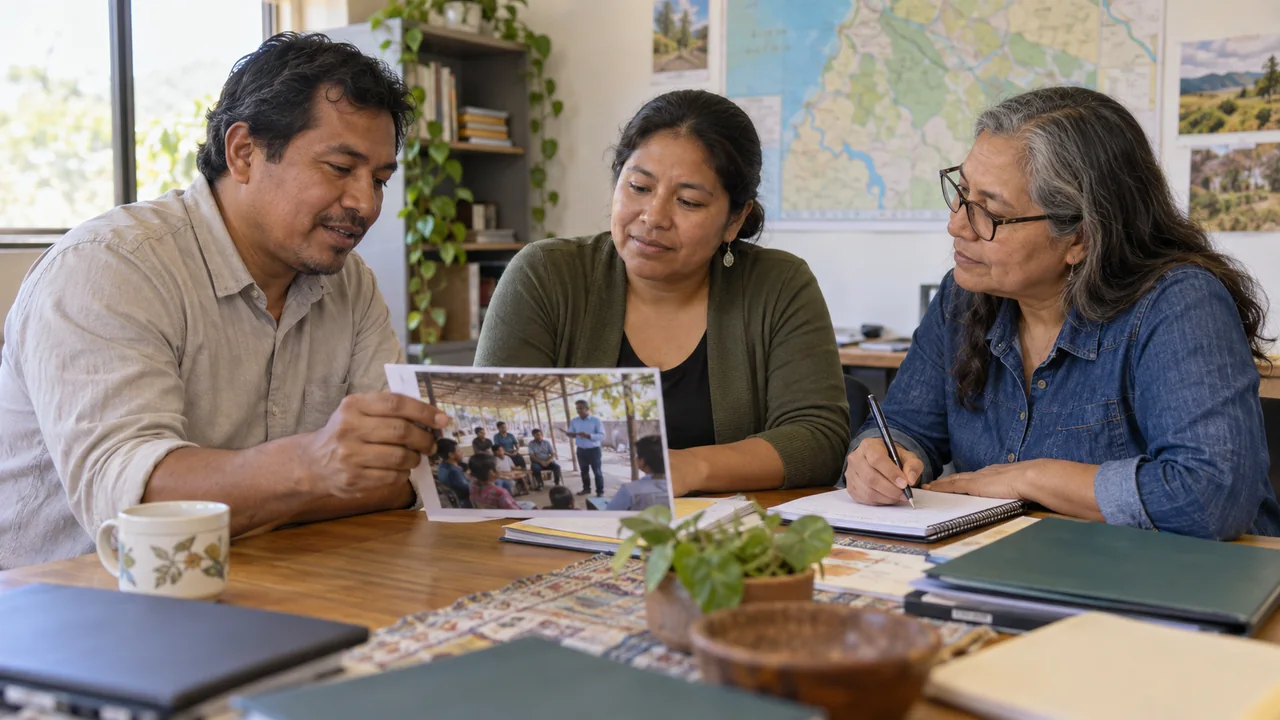
Show a real employer, instructor, or business owner explaining a specific part of the community's economy. A short account of how a training partnership works can make the relationship easier to understand than a list of institutions.
Put the story beside the relevant information and link to the source. Confirm names, quotations, dates, and outcomes with the participants.
For a real property, use current photographs of that property. For a general educational illustration, avoid presenting it as evidence that a facility, program, or client result exists.
The aim is to help a reader understand and remember a documented strength. Do not invent a local success story to fill a keyword gap.
Track AI answers about your community, accuracy, and inquiries
Create a small observation log before changing the site.
Choose a few stable questions based on the projects you pursue. Test them in the relevant search or answer experiences and record enough context to repeat the exercise:
| Record | Why it matters |
|---|---|
| Date, platform, and mode | Separates observations made in different conditions |
| Exact prompt | Avoids treating differently worded questions as identical |
| Relevant location or account context | Makes known differences visible |
| Community mention | Shows whether the place appeared in that answer |
| Cited URLs | Distinguishes a mention from a citation to your site |
| Factual accuracy | Identifies outdated or misleading statements |
| Action to take | Connects the observation to a fix you control |
Repeat the same small set over time. Save the answers you reviewed. Report the number of observations and changes in the answers without calling that a share of all site-selector searches.
Google says traffic from its AI features is included in Search Console's overall Web performance reporting. That report alone should not be presented as an isolated AEO score.
Keep observed AI answers, identifiable referral visits, and qualified inquiries as separate measures. A citation can be useful without producing an immediate visit; a visit is not proof of an investment decision.
Start community AI search work with a manageable EDO checklist
Pick one priority industry and five important questions.
List the page that answers each question, its evidence, its owner, and the biggest gap. Fix the weakest answer first. Then check that the related partner information agrees and that a visitor can reach the right contact.
Review the pages and your observation log on a regular cadence. Set a faster update process for changes such as a property becoming unavailable or a program closing.
Hallpass's recommendation is to make your community a clearer source of business information, then assess what happens. If your team needs help with the inventory, content, and website work, start a conversation about a Community Visibility Audit.